

Hacked Off
How I got locked out of my Instagram account, and how I got it back, via Dubai, some famous Instagrammers and ChatGPT

A couple of weeks ago I sat on a park bench in Hyde Park waiting for a Padel lesson to begin and randomly checked in to Instagram. A new follower’s face popped up that looked different to all the others. It had been a busy week — I’d done some commercial work on my social media with a brand — and I thought perhaps my reach had been widened as a result. But this guy’s comments were in Hindi. It looked like he lived in a small village in the middle of nowhere, he had a cute small child, and around 10 posts, maybe 140 followers tops. Possibly not following me because of the Noble Panacea talk I’d just done at the Chancery Rosewood that week.
The following day about 10 more appeared. I blocked them, most of them anyway — a couple I made disappear. “They won’t know,” said Instagram, in Instagram-speak. Could one have slipped through the net?
Tuesday, I sat on a panel talk about wellness and when it finished had that wonderful sense of relief wash over me. I must have been a little too relaxed, because when an email appeared in my inbox — complete with Instagram branding, the Meta logo and address at the bottom — asking me to pay attention to a potential breach of music copyright on a post I’d made about a brand founder who, it turns out, had recently passed away, I clicked right on. What was the song? Why was it in breach? Surely I’d have got it from the Instagram selection or Spotify? Instagram needed my email and phone number, so I entered them, dutifully, confident there was no breach of copyright.
And then another page. This time with a dark blue, very un-Meta background. A ticking digital clock telling me I had less than 24 hours to sort this out or—
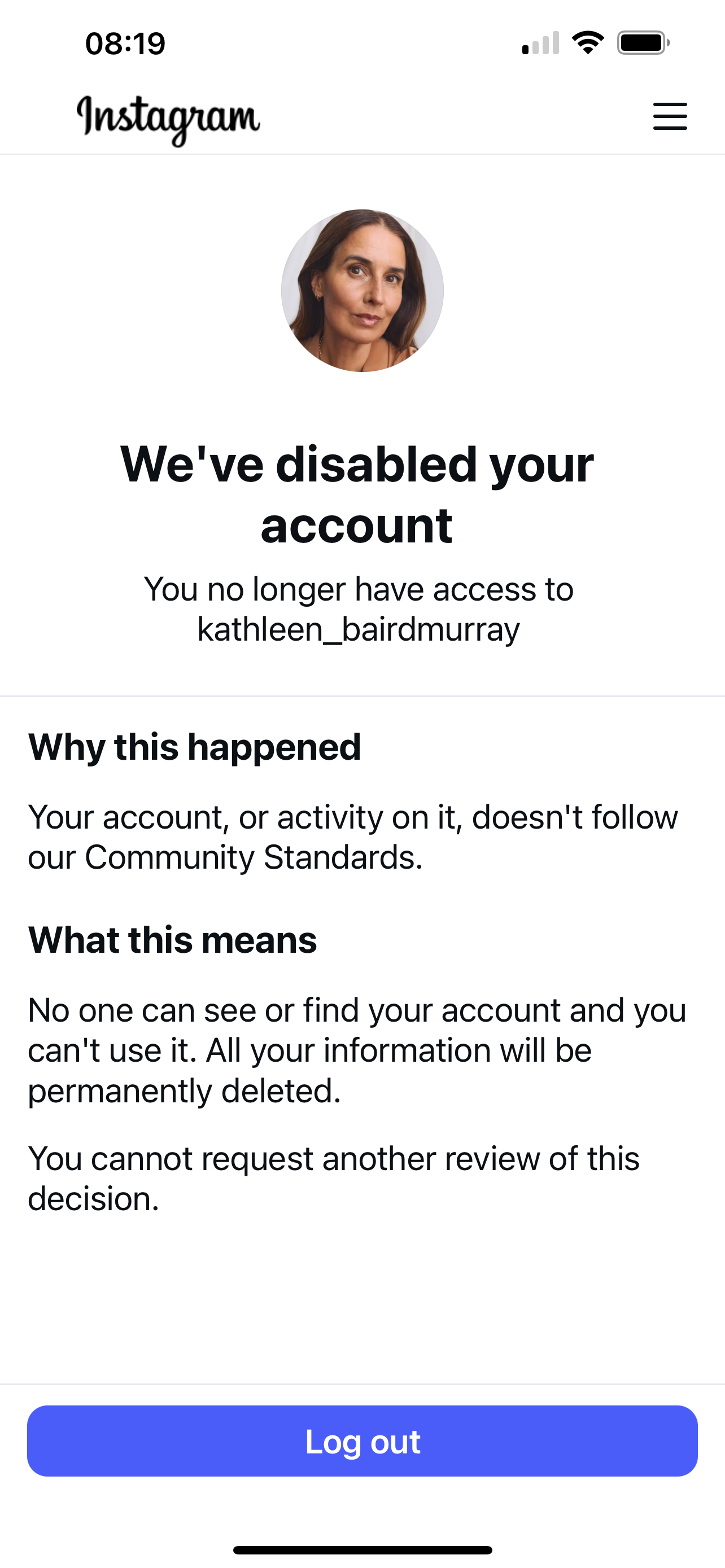
A message popped up saying I’d been locked out of my account. In fact it had been closed. In fact I would never get any of my posts back again. In fact, don’t even think of asking for a review. All with proper Instagram branding and official language, and now I didn’t know what was Instagram and what wasn’t any more.
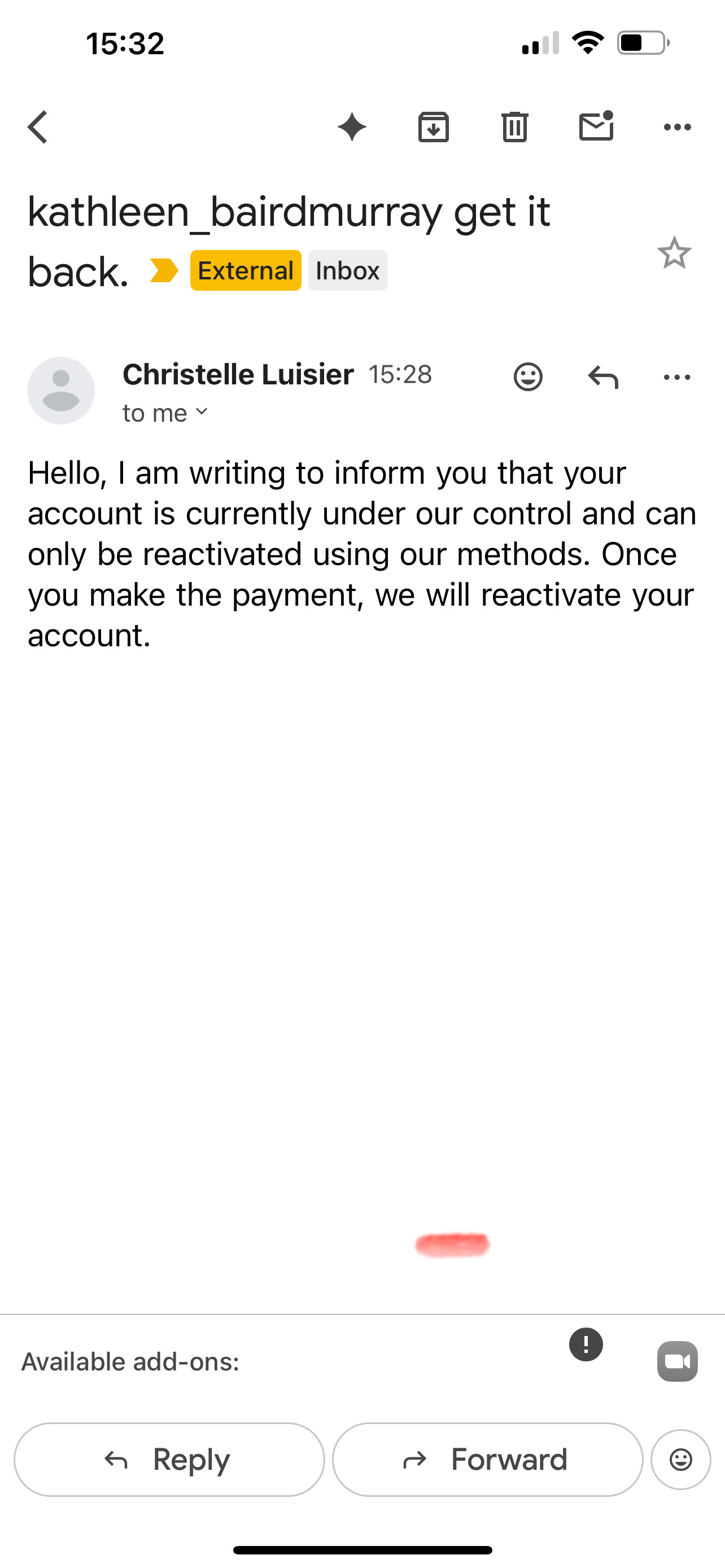
And then an email saying if I wanted my account back I needed to contact someone called Christelle Luisier (go figure) and it would cost me. I did not reply.
I really don’t like Instagram. I think it is a huge waste of all our time, and while I’m grateful to be back in touch with friends I’d lost track of, while I love dogs with guilty faces and SNL sketches, would my life be significantly improved without it? Yes, I think it would. I do it because it’s a commercial window to the world, and at this point as a journalist it has become significant — it allows me to earn a living. I know, crazy right? (For those who still believe that freelance journalists can make a living just being journalists: the going rate is 40 pence per word. When did you last read something more than 1,000 words long in a magazine? I rest my case.) I try not to make people cringe, not to look like a total narcissist, not to make people feel nauseated as they scroll over breakfast and see yet another picture of me. I don’t use filters but I aim for decent lighting. And the other reason I do it, and this may sound contradictory to everything above — is because I do believe that it is really important for women over 50 to be on there, before we become invisible from what is, like it or not, a cultural barometer.
But if I didn’t like Instagram much before, I really hated it now — on this side of the fence, outcast, able to see exactly how they treat their customers. There is no customer service. At all. You get trapped in a loop of hell between logging in, changing your password, and being locked out again. And on it goes.
I spent hours asking ChatGPT to help, and for a while it was really encouraging. “I know this doesn’t look good but it’s actually the first step to getting your account back!” it waxed enthusiastically. I took a half day off work to play loop-the-loop with Meta, all to no avail. “Now you just need to leave it alone for two to four hours,” said ChatGPT, seemingly abandoning me too.
What do famous people do? I wondered. So I asked them. I reached out to three friends with extremely decent followings and one came back, let’s call him Bob, with a friend of a friend of a friend in Dubai who might be able to help. “In the meantime, I’m going to ask you to do one thing, Kathleen,” Bob said down the phone — by this point I was whispering in a hallway, having already overshared/bored colleagues half to death. “I want you to manifest. You are so happy you’ve got your account back! Isn’t it great that everything is working again?!” Manifestation was not the fact-based, tech solution I had been looking for. But then, have you ever tried getting hold of someone at Meta? Exactly. Manifestation was suddenly a very real and plausible option.
Enter stage left, from New York, a fashion editor friend, let’s call her Rita, with this advice: “Talk to a social media manager at The Telegraph!” So I did, let’s call her Sue. Sue had had this happen to her only last week — on TikTok, she’d got rid of the hacker only to find they’d hidden and then pounced again once she was back up and running. The enemy within.
Sue looked at my Instagram profile, now consigned to a “page not found” situation and sighed. It wasn’t looking good. “Even with us, a newspaper corporation, there’s no Meta customer liaison officer. There just isn’t.” One hour later: “Weirdly I’ve just received an email from an actual person at Meta. You should email them!” I did. Six hours later I was still waiting for a reply. It never materialised.
Meanwhile, in Dubai, Bob’s friends, the hackers of the hackers were busy trying to get my account back. A deal was offered. $5,000 for the business account because it had seven IP addresses now attached to it, and this was apparently a very bad thing. $4,000 for the personal. “I’m going to push back,” said Bob. “I’ll tell them you’re a poor journalist.” His offer of $500 was laughed off with these exact words: “Bro, I’m running a business here!”
“Let me take a breath,” I said.
ChatGPT was appalled. The IP address thing? Meaningless. Unless those addresses could be traced to Moscow or Vietnam, they were almost certainly irrelevant to the hack. I must not hand over the money, it told me firmly. I decided to give Meta’s problem-solving prowess one last try and asked my 26-year-old son to babysit me through it. He wasn’t impressed. “What did you seriously think was going to happen once the clock had ticked its way down to zero?” he asked. Good point. After watching approximately 26 YouTube videos together we managed to unblock the La Pyae account. I think mostly it was luck — stumbling through the Narnia wardrobe somewhere within Meta’s never-ending loop of instructions that take you nowhere.
There was still no sign of my personal Instagram account.
“Are you okay? Daniel says your Instagram has gone and you didn’t reply to his WhatsApp last week…” Ah, lovely Hannah Coates. (Real name). I wasn’t okay. I was by this point genuinely stressed. My new agent was making some good commercial deals on my behalf — and what value was I to any of those brands without a place to post?
One last chance appeared in the form of a very big influencer bumping into a Telegraph colleague at a work event. My colleague asked if he knew anyone who could help, and without knowing me at all, he didn’t hesitate. The Meta contacts didn’t respond, but an agent friend of his did, let’s call him Angel, because he really was.
“I mean, if your influencer talent found themselves in this position, what would they do?” I asked Angel, having told him the whole lamentable Gen-X saga — including the ticking clock, the dark blue screen, the fact that I did not have 2FA switched on.
“Well,” he said, politely. “They wouldn’t have found themselves in that position.”
I emailed a copy of my passport and photos of the original correspondence. Days passed and with it hopeful promises that @kathleen_bairdmurray would come back on within 24 hours. Angel had some sort of supersonic secret-service access to Meta, thanks to representing some of the country’s most popular influencers. “They’ll get to it,” he said. “They have offices in China, offices in California. They’re always on.”
They did get to it. My own account kept blocking the code they were trying to send me — something I only discovered after Angel and I had almost given up. ChatGPT to the rescue: set up a Gmail account, tell Meta to use that instead. I obliged. Meta obliged. And just as quickly as I had been locked out, I was back in.
The whole experience of being locked out was overwhelming at times. Being back in was more of a convenience than anything else. But what if I hadn’t known anyone? No influencer friend, no agent friend with supersonic secret-service Meta access, no Telegraph colleague who happened to be standing next to the right person at a work event?
What I find quite extraordinary is that Meta — worth $1.6 trillion, no less — offers virtually no customer service, despite the fact that so many people depend on it to record and share everything from precious memories to serious commercial enterprises.
But on a positive note, if I didn’t believe in an “Instagram community” before, I do now. To the friends, colleagues and even the influencers who didn’t know me but went out of their way to help, I cannot thank you enough. And also, you’ll be pleased to know my 2FA is now on.
Love this!!
I have exactly the same feelings about Instagram! But would struggle to articulate them as well as you. It is important for women over 50 to be on there while it’s such a relevant cultural barometer, like it or not.